

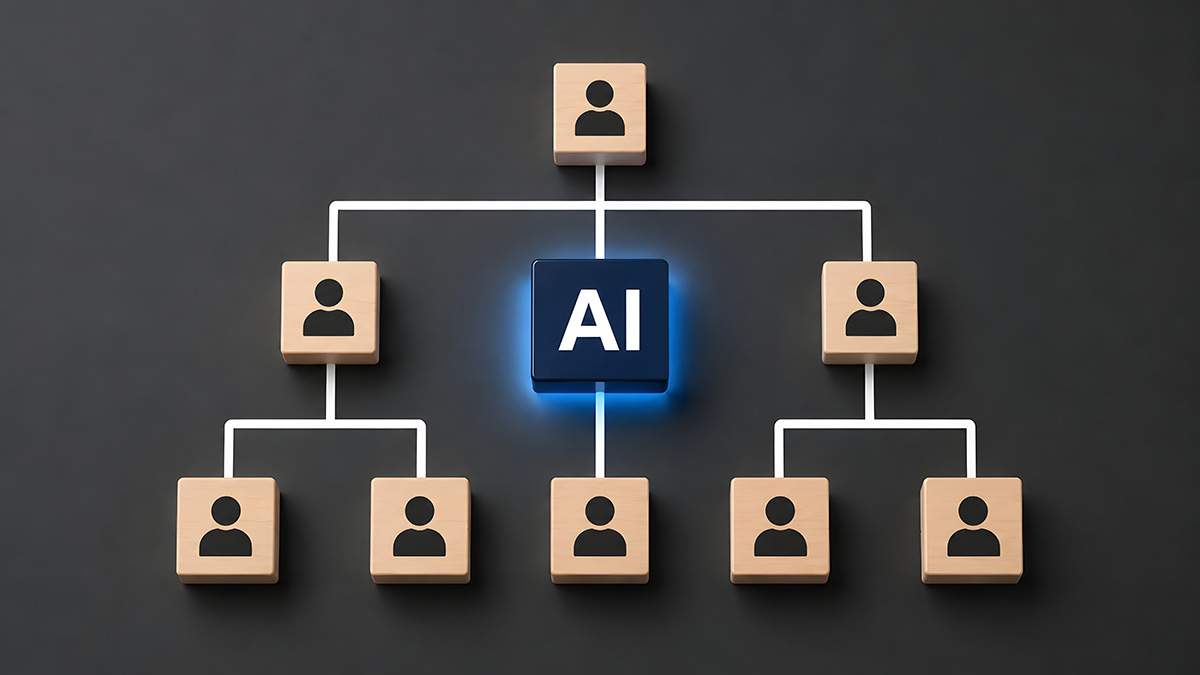
As businesses adopt AI tools like Microsoft Copilot and autonomous agents, many leaders are approaching AI as a software problem. In reality, it may be more useful to think of AI agents as a workforce problem.
Why?
Because modern AI agents increasingly behave like digital employees.
They access information. They perform tasks. They make decisions within defined boundaries. They interact with business systems. Most importantly, they operate using identities, permissions, and access rights that organizations must manage and govern.
As AI capabilities accelerate, organizations need to move beyond the question, “How do we deploy AI?” and begin asking, “How do we govern our digital workforce?”
The Shift from AI Assistant to AI Agent
Just a year ago, most organizations were using AI primarily as a productivity assistant. Employees asked questions, summarized documents, and generated content.
Today, AI is moving into a new phase.
Organizations are beginning to deploy autonomous and semi-autonomous agents that can perform specific business functions, coordinate work across multiple systems, and execute tasks with little human involvement. During our recent webinar, we discussed how Microsoft’s latest advancements are introducing environments where humans increasingly manage collections of AI agents that perform specialized business functions.
These agents may:
- Generate customer communications
- Research opportunities
- Analyze data
- Manage workflows
- Coordinate business processes
- Interact with other AI systems
The question becomes: How do you manage these entities safely?
A New Type of Identity
Every employee in your organization has an identity.
That identity determines:
- What systems they can access
- What files they can view
- What actions they can perform
- What data they can modify
AI agents operate the same way.
An agent’s capabilities are ultimately limited by the permissions and access rights assigned to it. If an agent is provided broad access to business systems, it may be able to view, process, or share information far beyond what was originally intended. Conversely, a properly governed agent operates within clearly defined boundaries.
This is why identity governance is becoming one of the most important disciplines in AI security.
The Hidden Risk Most Organizations Miss
Many organizations are rushing to deploy AI without first understanding their existing security posture.
The reality is that AI often exposes security weaknesses that already exist.
Overly permissive access rights, excessive administrative privileges, poorly classified data, and inconsistent governance practices may not cause obvious issues when employees work manually. However, AI systems can dramatically accelerate the impact of those weaknesses because they can process large amounts of information quickly and efficiently.
An agent can only access what it has permission to access.
But if those permissions are overly broad, the risk becomes significant.
This is one reason why organizations sometimes experience unexpected data exposure when adopting AI technologies. The AI didn’t create the problem. It simply revealed it.
Why Governance Starts with Security
Many organizations begin their AI journey by focusing on use cases and productivity gains.
While those benefits are real, governance must start with a security foundation.
Before deploying AI broadly, organizations should have:
- Role-based access controls
- Identity management processes
- Data classification policies
- Sensitivity labels
- Conditional access controls
- Monitoring and auditing capabilities
- Acceptable use policies for AI
Without these foundational elements, governance programs become difficult to enforce. As discussed in our webinar, security serves as the foundation upon which AI governance is built.
You cannot effectively govern what you cannot see.
And you cannot protect data if you do not know where it resides or who can access it.
Managing AI Like an Employee
Imagine onboarding a new team member.
You would likely:
- Define their role
- Grant appropriate permissions
- Provide training
- Establish policies
- Monitor activity
- Review performance and compliance
Organizations should take a similar approach to AI agents.
Before deploying an agent, leaders should ask:
- What business purpose does it serve?
- What information can it access?
- What systems can it interact with?
- What controls are in place?
- How will its activity be monitored?
- What happens if behavior changes unexpectedly?
These are governance questions, not technology questions.
And they are becoming increasingly important as organizations introduce more autonomous systems into daily operations.
Preparing for the Future of Work
The future workplace is unlikely to consist solely of people.
It will consist of people working alongside specialized AI agents, each with unique responsibilities, permissions, and access requirements.
Organizations that acknowledge this shift early will be better positioned to scale AI safely and effectively.
The winners in the AI era will not necessarily be those who deploy the most AI. They will be the organizations that successfully govern it.
Because in the years ahead, identity governance will no longer be limited to employees.
It will also include the growing population of digital workers operating alongside them.
Key Takeaway
AI agents should be treated as digital employees. They have identities, permissions, and access to business data. Organizations that build strong security foundations and governance practices today will be far better prepared to manage the AI-powered workforce of tomorrow.
Before deploying AI across your organization, make sure your security and governance foundation is ready. Contact KAMIND to learn how our AI Readiness Assessment and Guard+ security reviews can help you securely scale AI adoption.