

Information and data are the lifeblood of any business, apart from generating revenue. But today, business owners need a central place from where they can access all of the data. True, there are tools out there, but Microsoft has produced a new product called “Fabric”, which we explore further in this article.
What Is Fabric?
According to Microsoft, Fabric is as follows:
“It is an all-in-one analytics solution for enterprises that covers everything from data movement to data science, Real-Time Analytics, and business intelligence. It offers a comprehensive suite of services, including data lake, data engineering, and data integration, all in one place.”
(SOURCE: 1).
In other words, it pools together all of your information and data that your business has and puts them into one central view. As a result, you can get a bird’s eye view of any trends with regards to your customers and competition, and from there, make strategic decisions.
The SaaS Offering
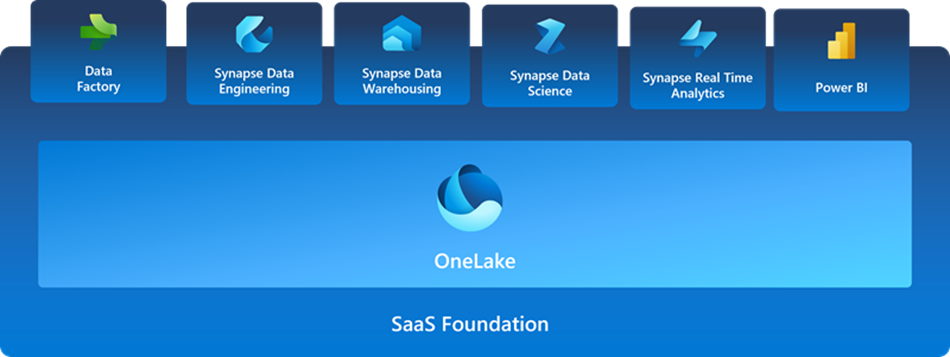
Fabric is available in Microsoft Azure, and because of that, it can integrate with the other data science tools which exist in it, such as:
- Power BI
- Azure Synapse
- Azure Data Factory
These are illustrated in the diagram below:
(SOURCE: 1).
With this powerful combination, your business will realize the following advantages:
- Deep insights into trends.
- Your teams can easily share all of the information and data so that you can best meet the needs of your customers.
- Your software development team can use these discovered trends to further enhance any applications that are in the pipeline.
- It acts as a central repository for your datasets.
- With this centralization, you can manage all of your information/data from one central location, which will allow you to better achieve compliance with the data privacy laws (such as the GDPR and the CCPA).
- You can still continue to use other data related products and services.
- There is seamless integration.
- Any security settings you apply can be inherited in a hierarchal manner.
- Labels can be easily applied to reflect the sensitivity of your datasets.
What Makes Up Fabric
Fabric is composed of the following, distinct components:
- Data Engineering: It comes with a very robust “Spark” based platform. More information can be seen at this link:
https://learn.microsoft.com/en-us/fabric/data-engineering/data-engineering-overview - Data Factory: You can make use of over 200 connectors to connect to any database (both SQL and non-SQL based) in your Azure Cloud deployment. More information can be seen at this link:
https://learn.microsoft.com/en-us/fabric/data-factory/data-factory-overview - Data Science: This can be used in conjunction with the Azure Machine Learning Studio, and other AI tools that are available in Azure. More information can be seen at this link:
https://learn.microsoft.com/en-us/fabric/data-science/data-science-overview - Data Warehouse: With this integration, you can quickly analyze extremely large datasets (such as in the Petabytes) in just a matter of minutes. More information can be seen at this link:
https://learn.microsoft.com/en-us/fabric/data-warehouse/data-warehousing - Real Time Analytics: This is primarily meant for collecting and analyzing what is known as “Observational Data”, which very often has no defined structure. Most of the data collected here qualitative in nature, such as videos and pictures. More information can be seen at this link:
https://learn.microsoft.com/en-us/fabric/real-time-analytics/overview
These functionalities are illustrated in the diagram below:

(SOURCE: 1).
Integration With One Lake
Azure consists of a platform which is known as “One Lake”. This has been designed to be the central repository for all of the observational datasets that are collected and stored. It’s main objective is to get rid of any kind of data silos, so that all software developers and data scientists can work collaboratively with one another. All of this can be done with the Fabric interface. This is illustrated in the diagram below:

(SOURCE: 1).
Conclusions
It is important to keep in mind that Fabric is still in the “Public Preview” stage, and thus is not available yet. But once it is fully released, it is anticipated to have the following pricing schemes:
- From Azure: You will be billed for every second that Fabric is in use.
- From M365: You can pay a fixed cost either on a monthly or annual basis.
If you have any questions about Fabric, or would like to learn how it can be deployed in your organization once it is fully released, contact us today.
Sources
- https://learn.microsoft.com/en-us/fabric/get-started/microsoft-fabric-overview